Animal Hand-drawn Poster Vintage Mountain
Prompt
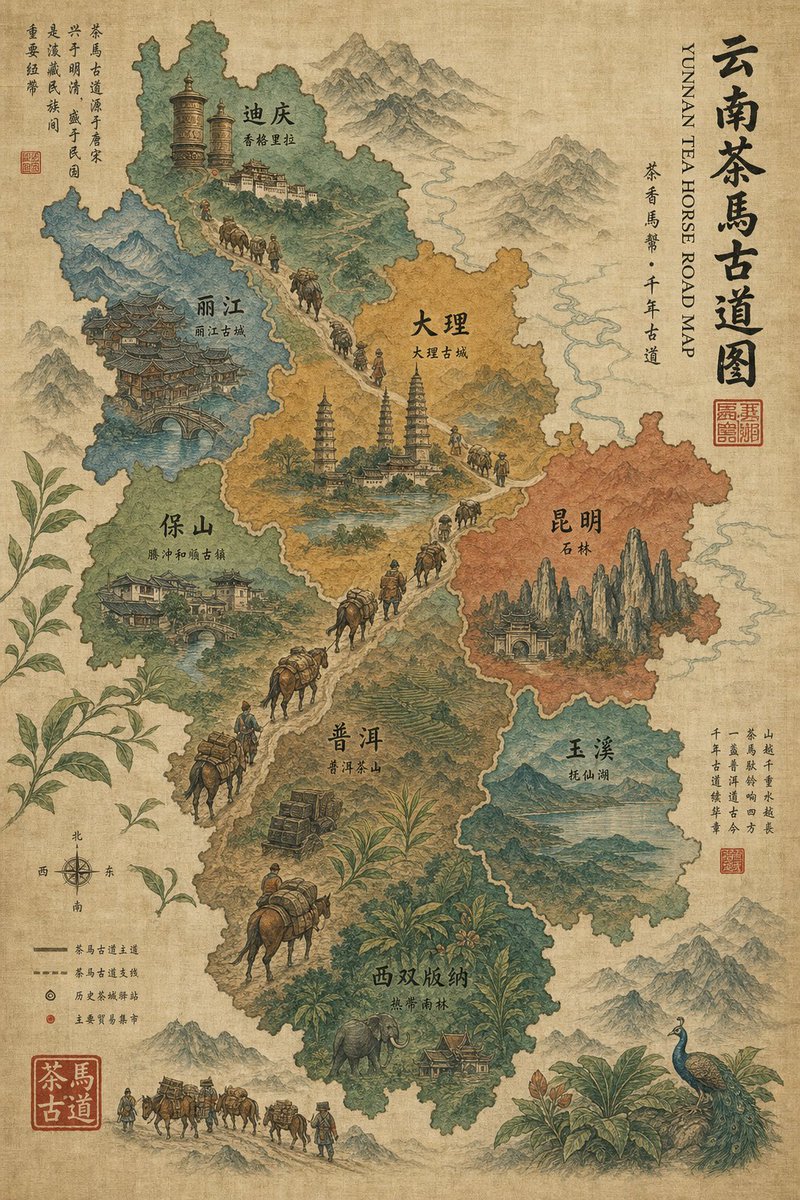
Goal: Create a vintage-style Chinese-style travel map, themed , presented as a hand-drawn parchment map showing the ancient caravan route through Yunnan. Canvas: 2:3 vertical poster, background is aged rice paper with worn texture, subtle stains, ink borders, and soft mineral pigments. The overall look should blend the style of a Qing Dynasty travel scroll with a fantasy historical map. Layout: Use the outline of Yunnan Province as a large central irregular shape, divided into 8 colored regions with soft ink outlines. A winding beige ancient caravan road enters from the lower left, passes through the center, and exits near the upper middle, connecting all major stops. Around the province, add faint monochrome mountains, rivers, clouds, and blank parchment space. Title and side text: Place a large vertical black brush calligraphy title “云南茶马古道图” on the right edge, accompanied by a smaller vertical English subtitle “YUNNAN TEA HORSE ROAD MAP”. Add small vertical Chinese calligraphy annotations in the upper left and lower right corners, and stamp two red square seals near the title and annotations. Map area: Include 8 labeled regions, each with a large Chinese place name and a smaller descriptive subtitle: 1) Northwest green region, “迪庆”, with Tibetan Buddhist monasteries and two pagodas; 2) Western blue region, “丽江”, with an ancient town, tiled roofs, and arched bridges; 3) Central golden region, “大理”, with three pagodas by the lake; 4) Eastern orange region, “昆明”, with stone forest peaks and city gates; 5) Southwest light green region, “保山”, with a market town and bridges; 6) South-central earth-green region, “普洱”, with terraced tea mountains and tea transport boxes; 7) Southeast blue-green region, “玉溪”, with Fuxian Lake scenery; 8) Far south dark green region, “西双版纳”, with tropical tea forests, elephants, and Dai architecture. Route details: In a small legend in the lower left, show 3 route styles: the main Tea Horse Road as a solid dark line, branch routes as dashed lines, and major trading posts as red dots. Above the legend, add a compass rose marked with East, South, West, and North. Caravan elements: Depict 6 clearly visible caravans along the route: 1) a group of people and pack animals departing from the lower left; 2) a group near 普洱 with two laden horses and a horse driver; 3) a group in the middle of the route, three laden pack animals climbing toward 大理; 4) a group passing the Three Pagodas of 大理; 5) a group entering the mountainous route of 迪庆; 6) a small distant caravan near the top route. Use brown horses and mules carrying stacked tea packs, accompanied by several robed travelers. Decorative elements: Add 4 main plant/animal decorations outside or near the map: 1) a sprig of tea leaves on the left; 2) a cluster of tea trees at the bottom center; 3) tropical broad leaves and flowers in the lower right; 4) a blue-green peacock standing in the lower right. Add a red seal in the lower left with the content “茶马古道”. Visual style: Fine black ink lines, watercolor washes, antique map illustration, Chinese landscape painting, mist-shrouded mountains, delicate river lines, traditional brush calligraphy, warm dark brown parchment background, and soft cyan, ochre, jade green, blue, and rust colors. Keep the image richly detailed but overall harmonious and aged. Constraints: Maintain the vertical poster composition, use clear handwritten brush Chinese labels, avoid modern roads, cars, buildings, icons, bright digital colors, photorealism, or clean vector graphics. No watermark.