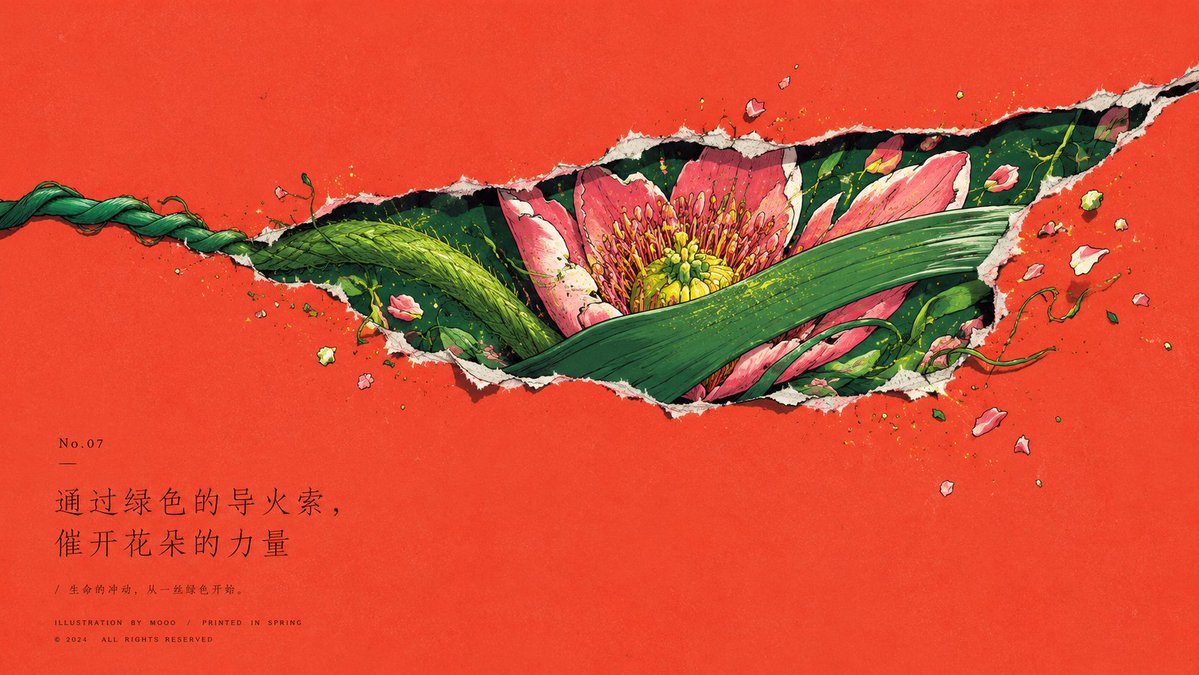
Torn-paper secret-reveal illustration
Prompt
Create a vertical graphic illustration poster centered on a specific theme. First, cover the image with high-purity structural color derived from the theme's mood, making it serve as a low-noise colored paper surface for occlusion, negative space, and breathing. The image does not establish realistic depth of field or a complete scene; instead, treat the background as a closed skin with slight paper texture, scan grain, and subtle printing unevenness. The main subject should not be fully displayed in front of the background. Instead, in the upper-middle part of the image, tear open a slightly tilted irregular horizontal crack from the paper surface. The crack should have white paper fibers, dark inner edges, sharp jagged edges, and a slight outward-turning texture, as if the inner world is pushing open the paper surface. The theme is revealed only through cropped key parts, recognizable edges, a small but intense focal point, and high-density fragments inside the crack. The focal area is small, but it must dominate first reading like a visual landing point, and be half-surrounded by a foreground occluding shape. This occluding shape is transformed from the theme's semantics, with gesture-like curves, close-up tactility, and horizontal guiding force, covering part of the focal point, making the viewing process produce a sense of brushing aside, discovery, and protected resistance. Subtle fragments derived from the theme gather at the crack edges, forming soft boundaries along the upper, lower, left, and right ends, partially spilling onto the paper surface, but not spreading evenly. These fragments are both content and part of the crack structure, pushing the inner world toward the external blank area through density, direction, and color points. Maintain a clear hierarchy of color areas: the largest area of structural color remains pure; medium-area subject life colors or material colors are used inside the crack; small-area emotional highlights flicker only near edge fragments and the focal point; dark anchors press on the focal outline, inner edges, and key occluders; the highest brightness is used only for torn paper edges, tiny highlights, and material cuts. The whole is completed with hand-drawn flat color blocks, clear blue-black or dark lines, slight paper texture, scan noise, and uneven printing grain, so that after objects are covered by the paper surface, they can still be recognized through partial contours, edge selection, and local density. The lower or quietest blank area retains a large amount of solid-color breathing room. If text appears, it is only as detailed titles, numbers, short phrases, and miniature footnotes, with restrained publication typography character, delicate strokes, wide letter spacing, and low interference. Text cooperates with blank space and does not steal the focus inside the crack. The entire image forms a cover-like feeling, that is, the solid-color blank area presses on the inner world, while the crack reveals the theme's secret, steadily maintaining order among the large quiet paper surface, upper-middle crack, high-density interior, single strong focal point, foreground occlusion, edge fragments, dark anchors, and low-key text. Theme: Background color: Aspect ratio: