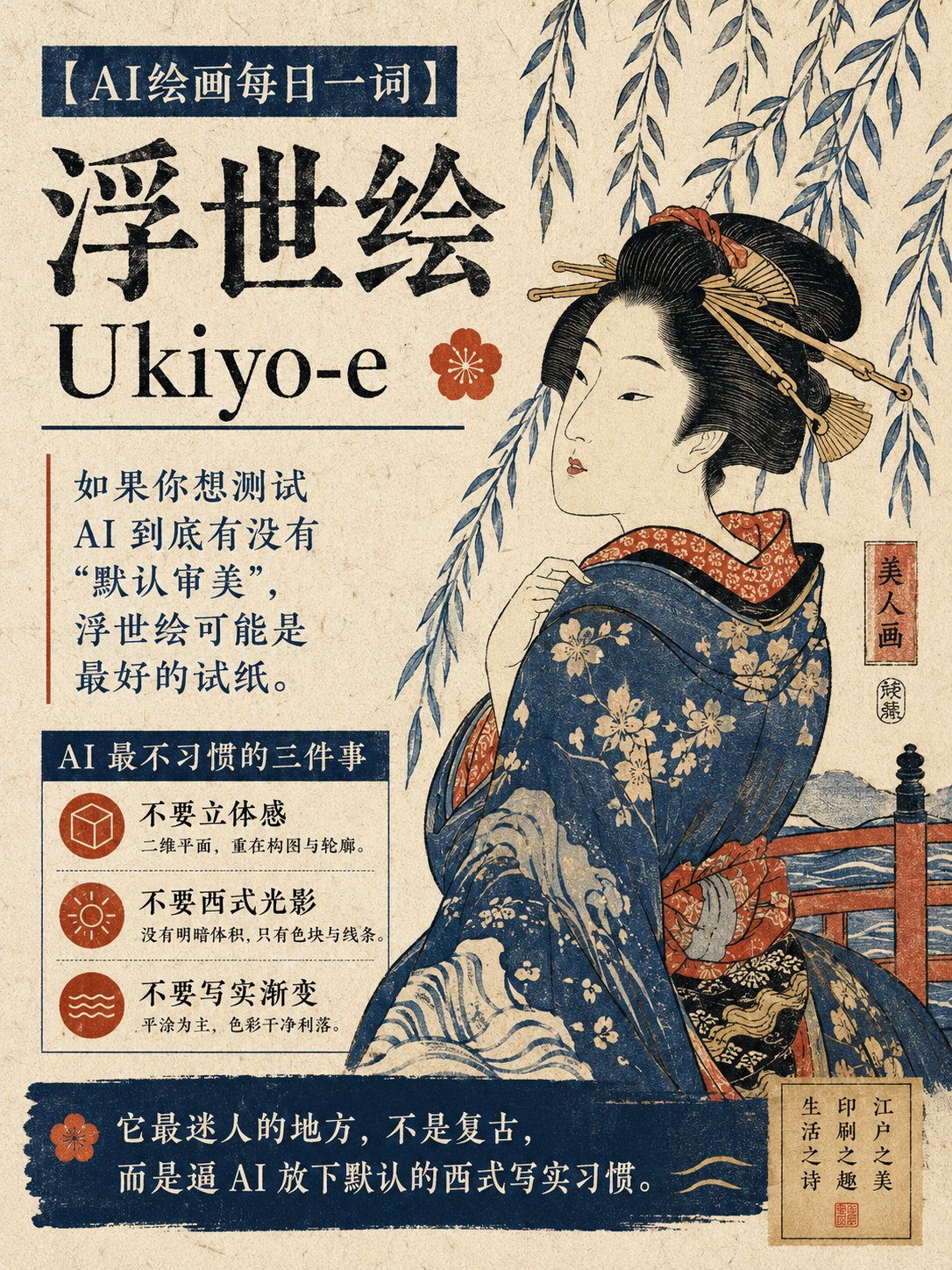
If you want to test whether AI really has a "default aesthetic," ukiyo-e may be the best litmus test.
Prompt
Because it just happens to require AI to do three things it is least accustomed to: no sense of volume, no Western lighting and shadow, no realistic gradients. The core of ukiyo-e is flat color blocks, strong contour lines, non-realistic colors, and woodblock print texture. But AI's instinct is often to secretly "paint the image into 3D," "retouch the face to have more shadow," and "transition colors more high-end." So the most interesting part of this style is not just that it looks good, but that it can force AI to put down many default visual habits. 🎯 Core Prompt You can write it directly like this: Generate a work in the ukiyo-e woodblock print style of 【subject】. Adopt traditional Japanese ukiyo-e print aesthetics, flat color block composition, thick and powerful contour lines, visible woodblock texture, asymmetrical composition, traditional washi paper texture, Edo period visual temperament, and the image includes 【scene description】. No three-dimensional depth, no realistic lighting and shadow, no soft gradients, no Western chiaroscuro modeling, no oil painting feel, no perspective vanishing point, no Renaissance-style sense of space. If you want a modern fusion version, change it like this: Generate a cyber ukiyo-e style work, reinterpreting 【subject】 in the manner of Edo period ukiyo-e woodblock prints, adding neon elements, electronic cherry blossoms, and futuristic city details, but preserving ukiyo-e's flat color blocks, black contour lines, woodblock print texture, and washi paper texture. No Western shadows, no 3D rendering, no realistic skin texture. The core structure of this type of prompt is: subject + ukiyo-e woodblock print style + flat color blocks + strong contour lines + washi / wood grain texture + NO constraint terms. 💡 Core Logic The key to this approach is not "adding an ukiyo-e filter," but constantly preventing AI from returning to its familiar Western realistic path. ① Flatness must be strong. Ukiyo-e does not create space through perspective, but expresses layers through front-back overlap and layout arrangement. So you must emphasize: flat color blocks, no depth, no perspective. ② Contour lines are the protagonist. Ukiyo-e lines are not auxiliary, but the skeleton. People, clothing patterns, waves, mountains, and trees must all stand through lines. So emphasize: thick contour lines, hand-carved print feel, powerful lines. ③ Colors must "look like prints," not "look like photos." Ukiyo-e blues, reds, and ochres inherently carry a non-realistic artificial feel. If AI starts giving you soft gradients and high-end skin tone transitions, then it has gone off track. One sentence to understand: To do ukiyo-e, do not let AI learn more, but let AI do less.