Flower Portrait Photography
Prompt
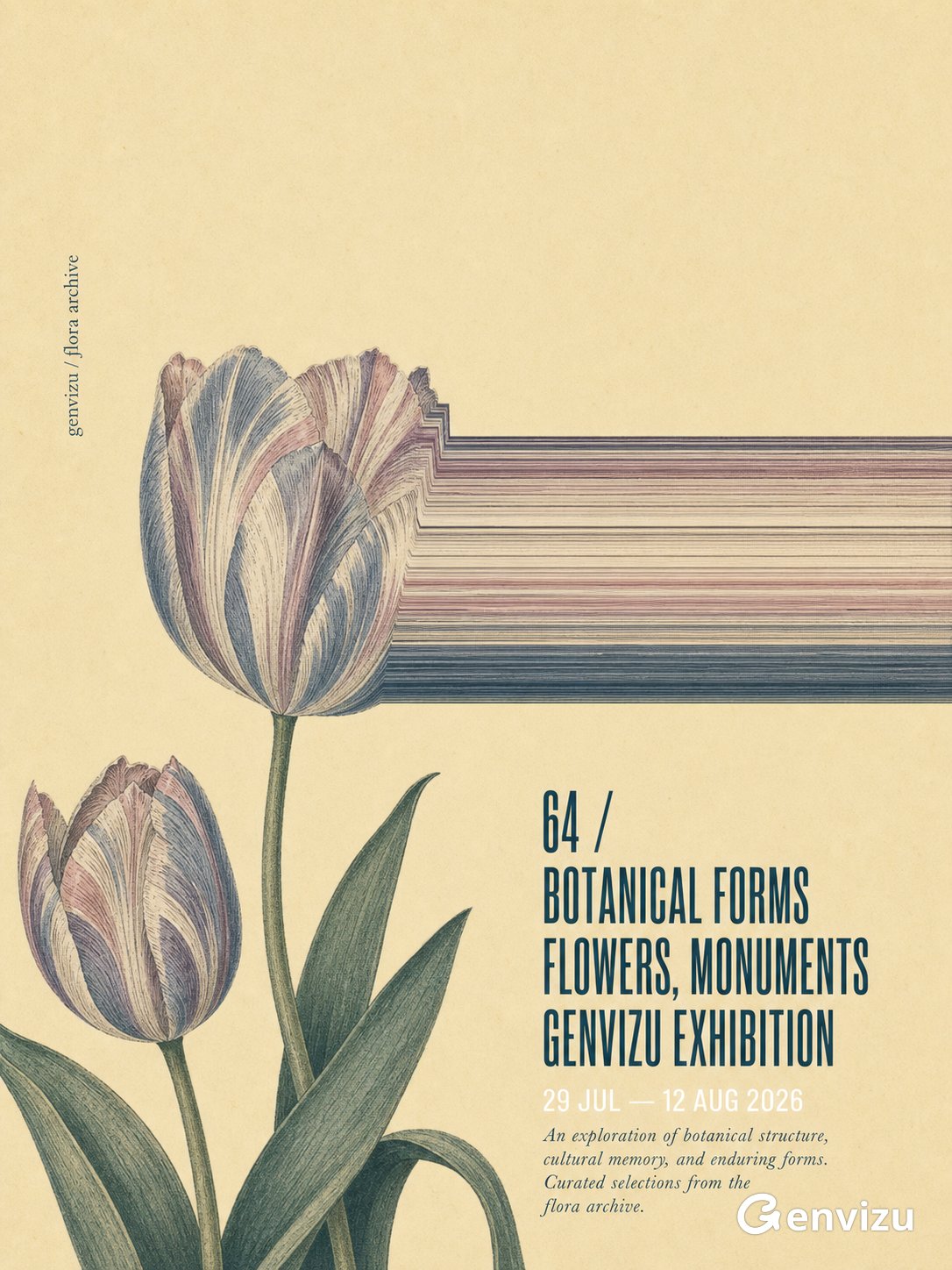
Create a 3:4 vertical vintage botanical exhibition poster. The entire canvas uses an even warm cream-yellow paper base color, with the top roughly one-third remaining almost blank. Two tulips grow from the bottom edge and are cropped by the canvas: the smaller one is in the lower left, and the larger one is in the upper-middle-left of the image; the petals have vertical stripes of gray-blue, pale pink, off-white, and smoky purple like an old botanical plate, with edges slightly suggesting dry paper fibers, and teal-green long stems and broad leaves interlace upward from the bottom, forming an irregular triangle. On the right half of the upper tulip, a strong and neat digital scan stretch occurs, and the petal colors are extended into multiple layers of horizontal color bands running through the right side of the image; the bands are composed of fine parallel lines of cyan-gray, pink-gray, beige, smoky purple, and deep cyan, with stepped corners at the flower connection, maintaining long-distance continuity to the right without affecting the lower flower. In the lower-right center, exhibition text is overlaid, using narrow sans-serif large type, tight leading, and left alignment: “64 / BOTANICAL FORMS / FLOWERS, MONUMENTS / GENVIZU EXHIBITION”; below it, in white medium-size text, write “29 JUL — 12 AUG 2026”, then in small deep-cyan italic serif type set a small amount of venue information. Near the upper-left edge of the upper flower, arrange a line of small vertical text “genvizu / flora archive”. The overall look is low-saturation silkscreen printing and old scanned botanical plate texture, with slightly uneven ink but precise layout; retain large areas of negative space and asymmetric balance. No third-party place names, logos, signatures, account names, QR codes, or watermarks; do not add borders, shadows, gradient glows, or extra decorations.