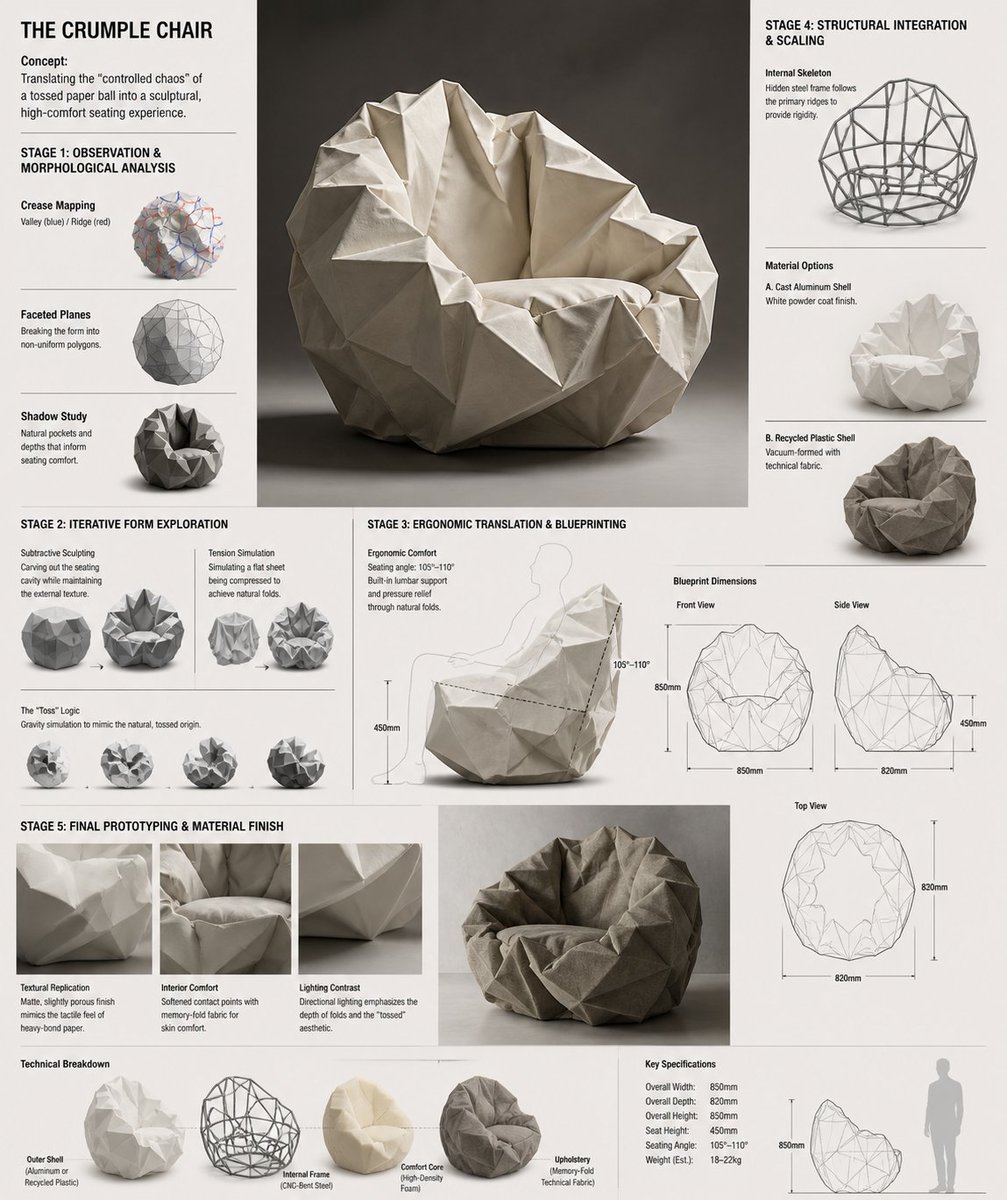
Crumpled paper furniture concept design
Prompt
Design concept: Core concept: Transform the "controlled chaos" of into a sculptural and highly comfortable seating experience.\n\nPhase 1: Observation and Form Analysis The goal is to deconstruct the imagery of crumpled paper into usable geometric data. Crease mapping: Identify the main "valley lines" and "ridge lines". These lines represent the chair's potential structural ribs or seams. Faceted planes: Decompose the sphere into a series of irregular polygons. Each plane of the paper becomes a potential panel for the chair's upholstery or shell. Shadow study: Analyze how the "crumpled" form creates deep grooves. These natural pockets guide where the user's weight is supported.\n\nPhase 2: Iterative Form Exploration Transition from sphere to seat through "digital crumpling". Subtractive carving: Imagine the paper ball as a solid. Use Boolean operations to "carve out" a seat recess that is both ergonomic and maintains the external jagged texture. Tension simulation: Use 3D software (such as Rhino or Blender) to simulate the compression of a flat material. This ensures the creases look real rather than "modeled". "Throwing" logic: Try gravity-based simulation, dropping digital meshes and observing their natural settling state, to mimic the rawness of "throwing".\n\nPhase 3: Ergonomic Conversion and Blueprint Drawing Elevate the raw aesthetic into a functional object. Comfort core: Overlay a standard ergonomic template on the crumpled form (seat angle: 105°–110°). Adjust the internal "creases" to provide lumbar support and pressure relief. Blueprint generation: Create technical orthographic views (front view, side view, top view). Plan dimensions: Seat height: 450 mm, total width: 850 mm. Surface smoothing: Keep sharp "paper edges" on the shell while softening internal contact points to ensure comfortable skin contact.\n\nPhase 4: Structural Integration and Scaling Make the concept physically feasible. Skeleton: Design a hidden internal frame (recommended: CNC bent steel rods or 3D printed lattice), distributed along the most prominent ridge lines of the paper creases to provide rigidity. Material selection: * Option A (high-end): , with white powder coating. Option B (soft): Vacuum-formed recycled plastic shell, covered with "memory crease" technical fabric to maintain the wrinkled appearance.\n\nPhase 5: Final Prototype and Material Finish Texture replication: Apply a matte, microporous finish to the material to mimic the feel of heavy paper. Light and shadow contrast: Use directional studio lighting in the final render to emphasize the "crumpled" shadows, making the chair look like a giant, discarded inspiration piece. Design suggestion: To maintain the authenticity of the "crumpled" look, avoid symmetry.