Cloisonné History Slides
Prompt
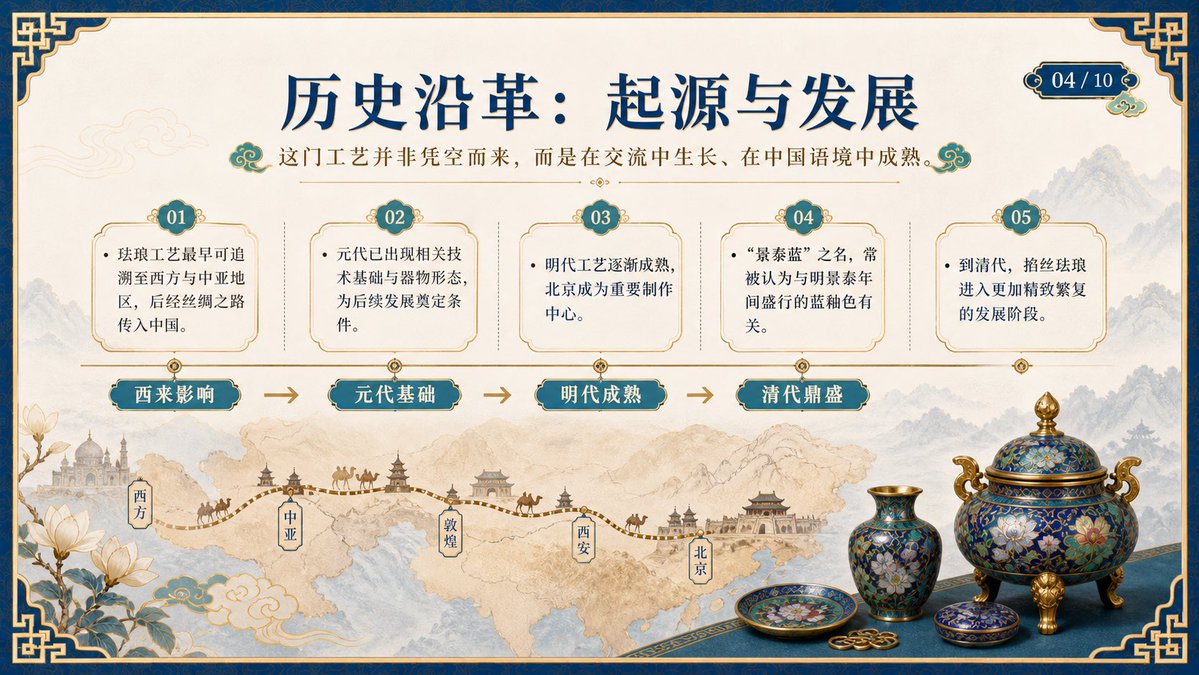
{"type":"Single-page educational PPT, using an ornate Chinese cultural style","canvas":{"aspect_ratio":"16:9 widescreen","background":"Warm ivory parchment texture with faint ink wash landscape, mist, and light blue-gray scenic textures","border":"Deep teal thick border, with gold double-line decoration and Chinese-style corner knots"},"theme":{"topic":"","subtitle":"","style":"Elegant museum course presentation style, classical Chinese decoration, blue-gold cloisonné enamel color scheme, strong academic atmosphere"},"layout":{"page_number":{"position":"Top right, inside an ornate lapis lazuli label","text":"04 / 10"},"title_block":{"position":"Top center","title_font":"Large bold deep navy blue Chinese calligraphic serif font","subtitle_font":"Smaller brown Chinese serif text","decorations":"Lapis lazuli cloud pattern decorations on both sides of the subtitle"},"timeline":{"position":"Mid-section spanning the full screen","count":5,"cards":[{"number":"01","position":"Left","text":"Enamel craftsmanship can be traced back to the West and Central Asia, later introduced to China via the Silk Road.","stage_label":"Western Influence"},{"number":"02","position":"Left center","text":"Related technical foundations and vessel forms appeared during the Yuan Dynasty, laying the conditions for subsequent development.","stage_label":"Yuan Dynasty Foundation"},{"number":"03","position":"Center","text":"The craftsmanship gradually matured during the Ming Dynasty, and Beijing became an important production center.","stage_label":"Ming Dynasty Maturity"},{"number":"04","position":"Right center","text":"The name 'Jingtai Blue' is often believed to be related to the blue glaze color popular during the Jingtai era of the Ming Dynasty.","stage_label":"Qing Dynasty Peak"},{"number":"05","position":"Right","text":"By the Qing Dynasty, filigree enamel entered a more refined and intricate stage of development.","stage_label":""}],"card_style":"Rounded cream-colored plaques with thin gold borders, topped with teal floral medallions with numbers, and a small black dot at the beginning of each text block","connector":"Thin horizontal gold line with small dots at nodes, and gold arrows between the teal stage labels"},"bottom_illustration":{"position":"Lower third","map":"Sepia Silk Road map stretching from left to right across mountains, with dotted caravan routes, camels, pagodas, city gates, and small vertical landmark labels","place_tags_count":5,"place_tags":["West","Central Asia","Dunhuang","Xi'an","Beijing"],"foreground_left":"White magnolia flowers and light ink cloud patterns","foreground_right":"On a deep teal tabletop, three ornate blue cloisonné enamel vessels are displayed: a floral flat plate, a tall vase, a large covered censer with gold handles and base, plus a small round covered box and several gold rings","object_count":5},"visual_requirements":"Create a refined finished PPT page, not a mockup. Use clear and readable Chinese fonts, balanced spacing, antique watercolor textures, and highly detailed blue-gold enamel vessel illustrations. Keep the five timeline cards clear and aligned, with no stage label below the fifth card. Maintain a high-end courseware aesthetic suitable for a cloisonné history lecture."}